THIS PROCEDURE MUST BE PERFORMED BY A QUALIFIED TECHNICIAN.
NOTE: If using BACnet control, the outdoor temperature sensor may or may not be used. Follow the instructions included with the BACnet Controller.
NOTE: Outdoor sensor wire MUST NEVER be combined with other control wiring in a multi-conductor cable.
Theory of Operation: The outdoor sensor monitors outdoor temperature and provides this in formation to the system. The system responds by automatically storing heat in its brick core according to outdoor temperature and the heating requirements.
Location of: The outdoor sensor must be placed in a location where it can accurately sense outdoor temperature and is not affected by direct sunlight or other abnormal temperature conditions.
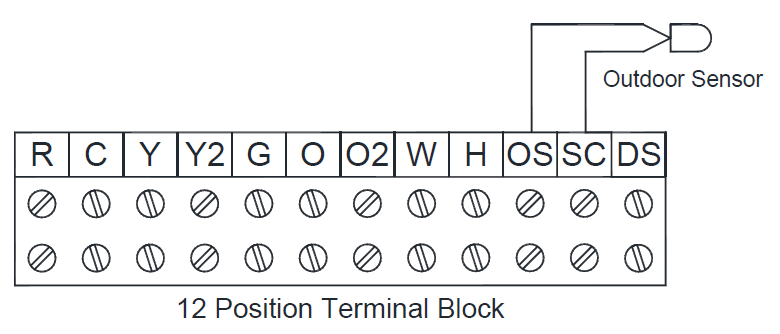
Installation Methods: The outdoor sensor can be hard-wired to the system’s “OS” and “SC” terminals (default) or it can be connected to the Power Line Carrier (PLC) transceiver. When using BACnet control for outdoor temperature, the outdoor sensor will not be used.
Wiring:
-
Route low voltage wire from the outdoor sensor to the electrical compartment through one of the low voltage wire knockouts.
-
Connect to “OS” and “SC” as shown below:
-
If the sensor wiring is routed through an external wall, the opening through which the wire is routed MUST be sealed. Failure to do so may affect the accuracy of the outdoor temperature sensor.
-
The outdoor sensor is supplied with a lead length of 40 ft. If a greater wire length is needed, it can be extended to a total of 250 ft.
-
Unshielded Class II (thermostat) wire can be used as extension wire provided it is segregated from any line voltage cabling.
-
No other loads can be controlled or supplied through this cable. It is for connection of the outdoor sensor ONLY.
-
This low voltage cable MUST not enter any line voltage enclosure.